
I’ve been going to Universal Studios Florida since the early 2000s, long enough to remember Jaws and to miss it now that it’s gone. My kids grew up riding the early movie-focused rides, watching Twister spin its tornado, and experiencing the scrappy, thrilling version of Universal that existed before Harry Potter changed everything. We’ve watched this resort transform more times than most families visit Disney World, and after 25 years of loyalty, I felt like I had to be there for Epic Universe in its opening summer. Here’s what we learned from our June 2025 trip, and what it taught me about how Universal continues to evolve.
Old Universal: Jaws, Twister, and the Days Before Potter
My first memories of Universal Orlando are vivid and specific. Jaws was our ride. The animatronic shark, the tension in the boat as it glided through those murky waters, the genuine gasps when the creature lunged: it felt dangerous and thrilling. Twister, with its flying cows and roaring wind, was the other showstopper. These were the attractions that made Universal feel different from Disney. You weren’t in a storybook fantasy world; you were dodging a mechanical shark or standing in a tornado. The park had an edge.
Back then, Universal was a solid one-day destination. You could see most of it in a full day if you moved purposefully. The resort had no Harry Potter, no Islands of Adventure as its own park, and CityWalk was a place you went to eat between park days, not a destination in itself. I took my kids through the park over multiple visits during that era, and every time felt like we were discovering Universal as it actually was: raw, movie-driven, and unafraid to get a little dark. Plus, it was much more affordable than Disney World when we started going.
Both Jaws and Twister are gone now. Jaws closed in 2012 to make room for Diagon Alley. Twister shut down in 2015 as Universal cleared space for the Race Through New York. I won’t pretend I wasn’t nostalgic the first time I walked past those vacant spaces. But I also understood why. Universal isn’t a park that rests on its attractions. It reinvents them.
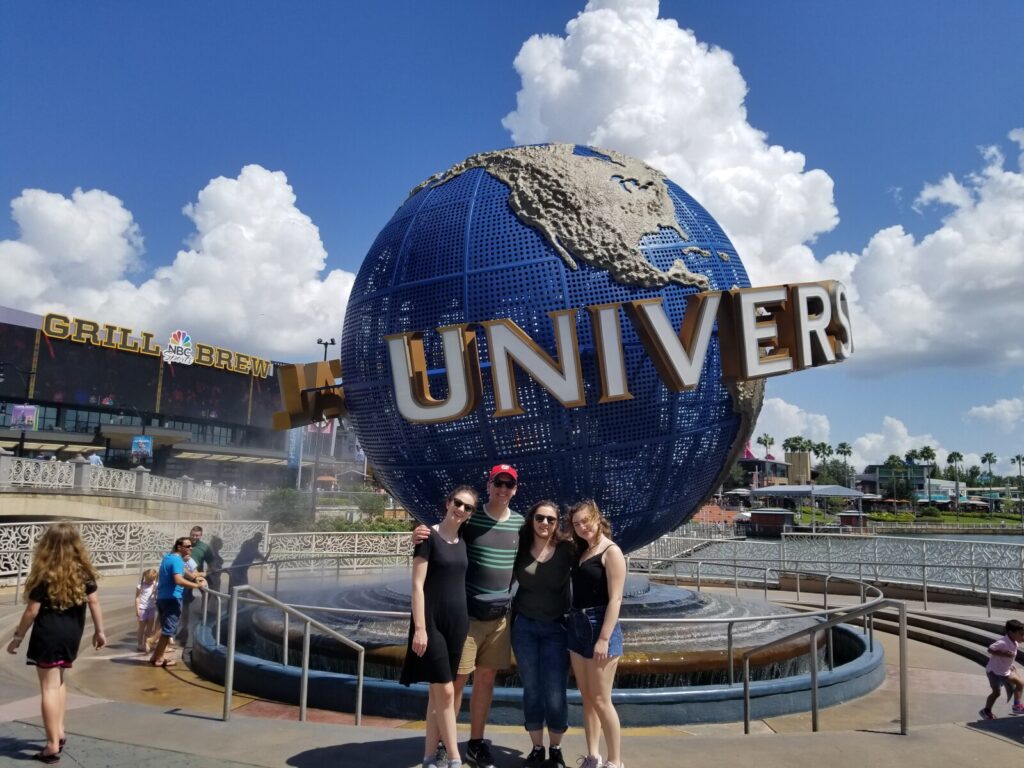
Still, some Universal traditions never fade. My family has a ritual: on every trip, no matter what else we skip, we snap a photo in front of the iconic Universal globe out front. I have pictures of my kids there spanning nearly two decades: growing taller, changing expressions, the same spinning globe behind them every time. It’s become the marker of continuity at a park that’s otherwise always changing.
The Potter Effect: When Universal Became a Multi-Day Destination
The biggest turning point at Universal Orlando came in 2010 with the debut of the Wizarding World of Harry Potter in Islands of Adventure. For the first time, Universal wasn’t competing with Disney on Disney’s terms. They were offering something that felt genuinely immersive, themed, and essential to a certain audience. Within four years (2014), they extended the experience by opening Diagon Alley in the original park and connecting the two lands with the Hogwarts Express.
That single addition changed how people planned vacations. Universal went from a “one-day side trip” to a “two-day, maybe three-day” destination. Suddenly you needed multiple days. You needed a hotel. You weren’t just trying to fit Universal in; you were building a vacation around it.
By the mid-2010s, the transformation was complete. The resort had grown into an ecosystem: two major theme parks, a water park (Volcano Bay), a robust entertainment district (CityWalk), and multiple resort hotels with escalating amenities. Each visit revealed new attractions, new restaurants, new experiences. The Simpsons area replaced Back to the Future. New restaurants appeared in CityWalk. The whole place kept evolving.
But here’s what’s important to recognize: these changes didn’t feel like Universal was chasing Disney. They felt like Universal was staying true to itself while expanding the scope. It was always still about the movies, the thrills, the immersion. Potter just gave them permission to go deeper.
Building a Legacy of Opening-Year Adventures
One thing my family became known for over the years was showing up for Universal’s biggest debuts. We were there when Velocicoaster opened at Islands of Adventure in 2021. I remember the pre-dawn energy, the excitement of experiencing something genuinely new, the technical marvel of a coaster that launches from zero to 70 mph in 2.4 seconds while dinosaurs literally snap at your head. We got a photo on that ride that captures exactly what I love about Universal: pure adrenaline and storytelling combined. That first year of Velocicoaster was special. The ride had perfect execution, the queue was themed to the minute, and the whole experience felt like an event.
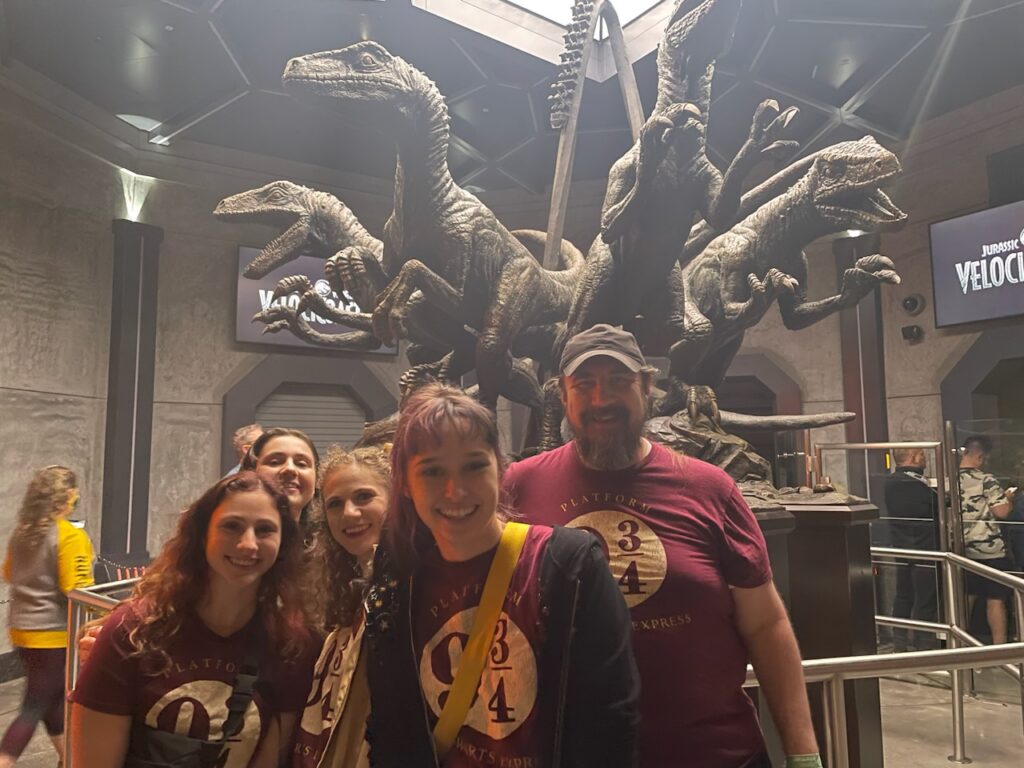
That same year, 2021, Universal opened Fast & Furious: Supercharged (the ride, not just the name). We waited a long time for that one too, expecting something equally impressive. What we got was disappointing. The underlying technology is the same as Kong Skull Island, motion-based simulator vehicles moving through a space with projections and practical effects, but the storytelling is flat. Fast & Furious is about being recruited into Dominic Toretto’s crew to evade police or something. There’s no real narrative tension, no character motivation, no reason to care. Kong Skull Island, by contrast, has you trekking through a jungle, building dread about what’s coming, actually encountering the creature in progressively threatening ways. The technology is identical, but the story execution is night and day.
That experience taught me something important: Universal’s success isn’t just about having the latest technology. It’s about marrying that technology to compelling storytelling. When they get it right, Velocicoaster, Mummy, the new Mario Kart, it’s magic. When they get it wrong like with Fast & Furious, people feel the difference immediately, even if the ride system is state of the art.
Planning Epic Universe: Strategy for Opening Summer
When Epic Universe was announced for spring 2025, I immediately marked my calendar. This wasn’t another land; it was an entirely new theme park. Universal’s third major park, fourth if you count Volcano Bay. The fact that it was opening in May meant the early summer would bring both the peak crowds of opening fervor and the excitement of seeing something genuinely new. For a longtime Universal fan like me, it felt essential to be there.
My travel group was five adults: myself, my daughters, and son-in-law. We’re all Universal loyalists. We usually visit Universal at least once, if not twice, each year. We wanted to be strategic about this trip because we only had a few days, and we wanted to maximize our time in the new park without burning out on the old ones.
I planned a split-stay approach. The key insight was this: stay on-site for one night to score Early Park Admission to Epic Universe, then move to a less expensive hotel off-site for the rest of the stay. You get the perks without the price tag for an entire multi-night stay.
Night One: Cabana Bay Beach Resort
We booked a single night at Universal’s Cabana Bay Beach Resort in a Family Suite (exterior entry) for all five of us. The total was $259.88 with tax. Cabana Bay is a retro-themed resort: bright colors, 1960s vibes, a long lazy river, and it’s more affordable than Universal’s premium properties (like Hard Rock or Portofino Bay). The key perk wasn’t the resort itself (though the vibe is fun); it was the Early Park Admission that comes with any Universal hotel stay.
Nights Two and Three: Fairfield Inn & Suites
After Cabana Bay, we moved to the Fairfield Inn & Suites near Universal. Room 612, five of us squeezed in, for three nights (June 6–9). Total cost: $472.50. It was a standard hotel room, nothing fancy, but it had free breakfast and was only a few minutes’ drive from the parks. Compared to spending three more nights at Cabana Bay or another on-site resort, this was a massive savings, roughly $400–500 less for three nights, and freed up budget for Express Passes for Epic Universe.
Speaking of Express Passes: this was the decision that shaped our whole day.
Early Entry: Our 7:00 AM Advantage
On June 8, we woke up at Cabana Bay around 6:00 AM. The sun was just coming up. We grabbed breakfast (Cabana Bay has a small café), checked out by 6:15 AM, and drove ourselves to Epic Universe rather than taking the shuttle. We wanted to be there as early as possible.
By 7:00 AM, we were at the Epic Universe gates. The atmosphere was electric and sleepy at the same time, hundreds of people, many in resort gear, all waiting for the Early Park Admission to begin. As Cabana Bay guests, we got scanned in for early entry before the general public gates even opened.
The first thing we did was head straight for Harry Potter and the Battle at the Ministry, the biggest new attraction, the one everyone would rush toward at rope drop. The queue was moving the entire time we were in the line, and we walked on within minutes, and even though the ride wasn’t supposed to start running until official park opening (around 8:00 AM), it was operational when we arrived, and by 8:00 a.m., we had ridden what many people would spend two hours in line for later in the day.
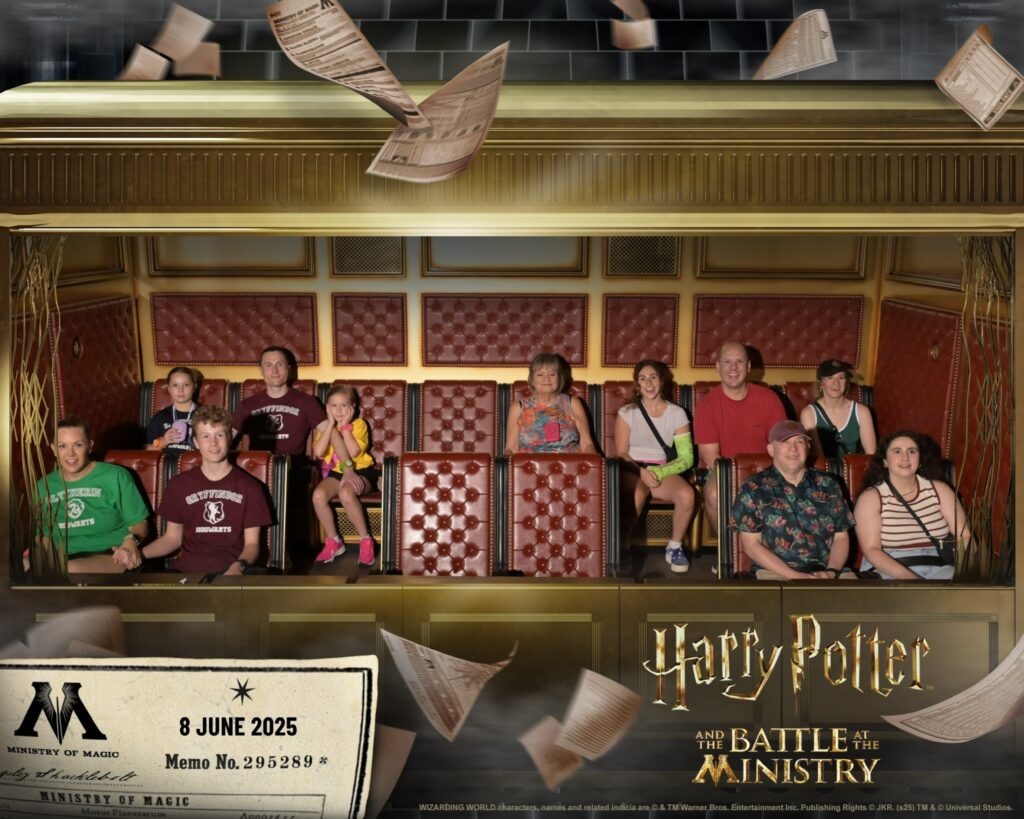
That one-night stay at Cabana Bay paid for itself in those first 15 minutes.
In the Park: Using Express Like a Weapon
Once the park officially opened at 8:00 AM, the crowds started flowing in. Within an hour, the park went from tranquil to busy. This is when our Express Passes became our secret weapon.
Epic Universe is organized differently from the classic Universal parks. Instead of a big loop or circle, it’s built around a central hub called Celestial Park, with four distinct worlds branching off: Super Nintendo World, the Dark Universe (classic Universal Monsters), Isle of Berk (How to Train Your Dragon), and the Ministry of Magic area. The layout is massive, 750 acres across the entire resort property, and it requires a lot of walking compared to the older parks.
We spent the day moving between lands, using Express to hit the major attractions. Here’s how it played out:
Mario Kart: Bowser’s Challenge (Super Nintendo World) – This is the marquee attraction in Nintendo World. The standby wait posted 90 minutes. With Express, we waited 20 minutes, then stepped into AR goggles for a race-through-the Mushroom-Kingdom experience. The technology is genuinely new; you’re wearing goggles that layer digital visuals onto physical sets as you race. It’s not just projection mapping; it’s an AR experience built into a ride vehicle. I’ve never felt anything quite like it at Universal before.
Yoshi’s Adventure – The family-friendly Nintendo ride. Standby: 60 minutes. Express: 5 minutes. We basically walked on.
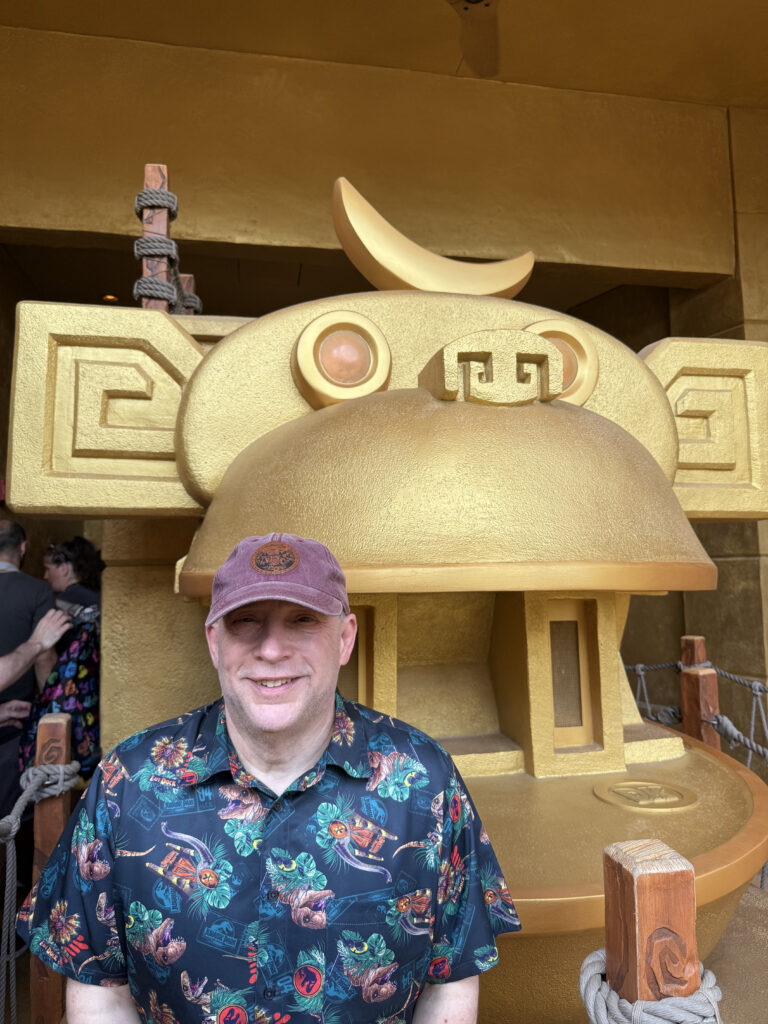
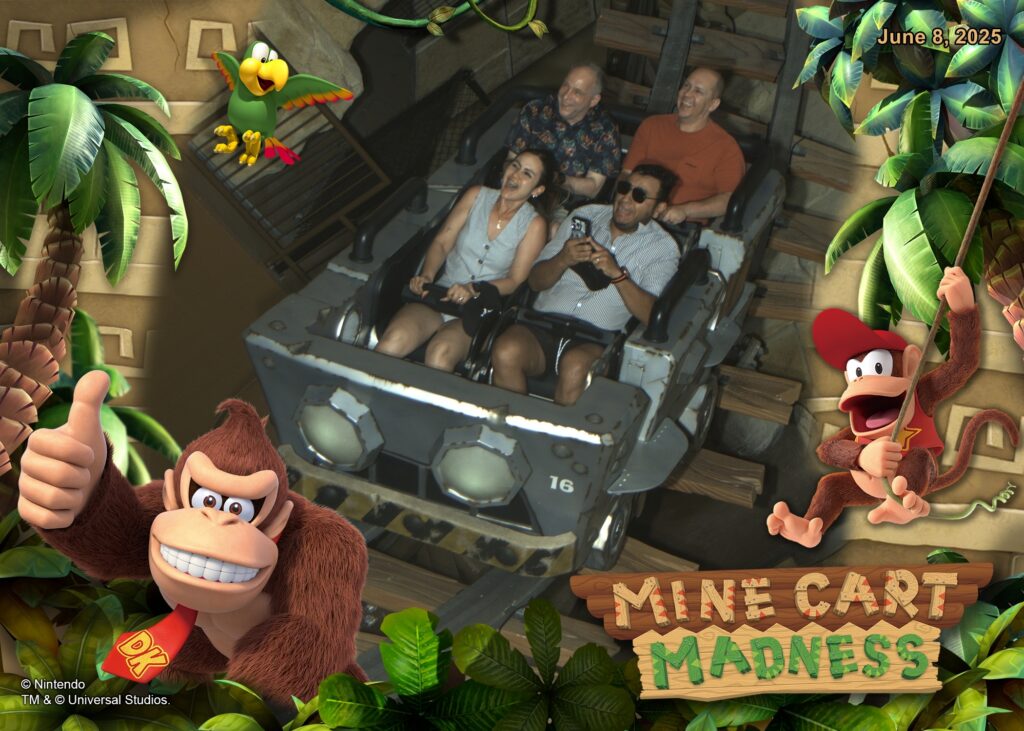
Donkey Kong Mine Cart Madness – Here’s where things got real. This coaster was supposed to be our next priority, and it broke down within the first hour of operation. We got in line, waited about 30 minutes, and then they told us the ride was down. We came back later in the afternoon. It broke down again. We came back a third time, waited three hours in the line due to inclement weather (not Express Pass eligible at opening), and finally rode it around 6:00 PM. The ride did not disappoint: it uses an innovative tilting track to make your car feel like it’s jumping broken platforms, just like in the video game. But it clearly had some kinks to work out during opening operations.
Stardust Racers – A dual-track racer coaster in the central Celestial Park hub, not Express-eligible at opening. We waited 45 minutes standby for this one. It’s a fun, spacey coaster, and the evening ride was better than the afternoon version; you could see the lights and theming more clearly.
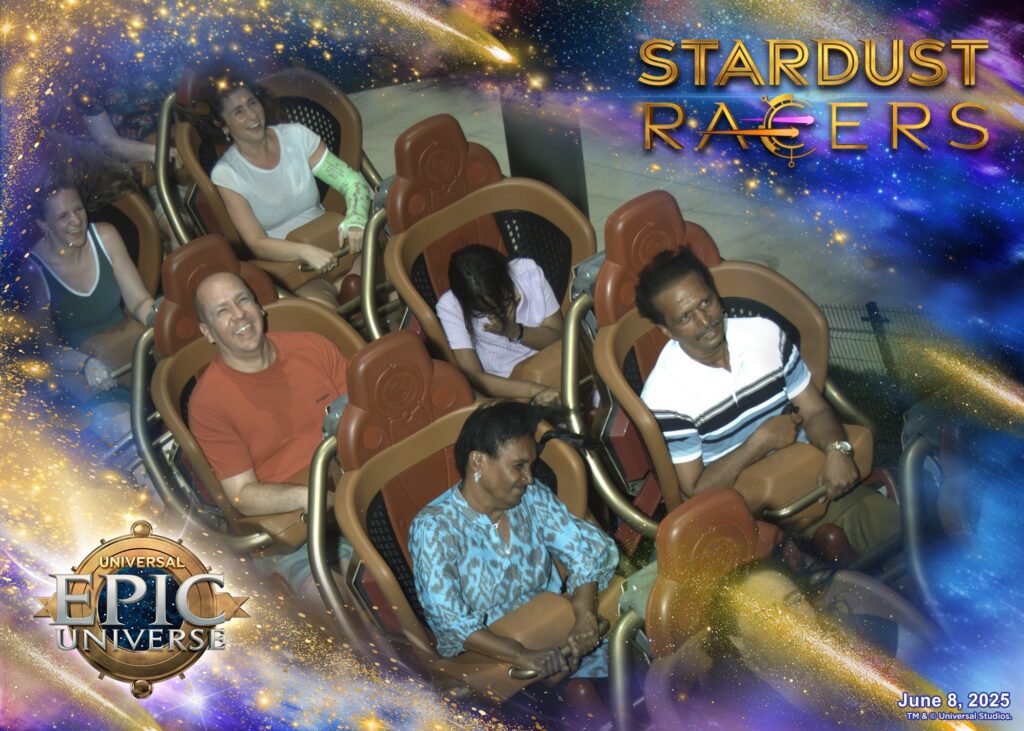
By midday on June 8, the park was absolutely packed. Every queue was long. Every restaurant had a line. The bathrooms had waits. But because we had Express, we never felt that pressure. While standby guests were waiting 60–90 minutes per attraction, we were seeing multiple attractions in the same time span.
How Epic Universe Feels Different
After spending 25 years visiting Universal, I noticed several things about Epic Universe that set it apart from the classic Universal parks:
Technology – The rides here are noticeably more advanced. Mario Kart’s AR goggles represent something new in the theme park space. The trackless dark rides (like Harry Potter) are seamlessly executed. The animatronics in the Dark Universe attraction are startlingly lifelike. Universal Studios and Islands of Adventure are phenomenal, but Epic Universe feels like the next generation of ride engineering.
Layout and Scale – Epic is built more openly, with wider pathways and a central hub that breaks up the intensity of the themed lands. The classic parks feel like you’re walking through a series of interconnected neighborhoods. Epic feels more like you’re traveling between distinct planets. Each land is self-contained, almost portal-like in how you enter and exit it. This is partly a design choice to reduce crowding (it seems to work) and partly an intentional effort to make each land feel more immersive.
Theming – The lands in Epic are almost entirely new. Nintendo World, the Dark Universe, Isle of Berk, and Ministry of Magic didn’t exist anywhere else before. In contrast, the classic parks draw heavily from existing franchises and attractions. Epic prioritizes creating brand-new themed environments, which gives it a sense of discovery that even seasoned Universal visitors don’t usually experience.
Crowds – Opening summer crowds at Epic were intense. The new park drew people who specifically came to see something brand new, plus all the regular summer tourists, plus locals on opening specials. By midday, choke points around popular attractions and restaurants got congested. That said, the park’s design (open pathways, rest areas, street entertainment in the hub) managed crowds better than I’d have expected.
CityWalk and the Timeless Attractions
No Universal trip is complete without CityWalk, and we made an evening run there to check out the dining scene. My family is obsessed with the Toothsome Chocolate Emporium & Savory Feast Kitchen, a steampunk-themed restaurant with decadent milkshakes, sundaes, and creative entrees. We grabbed a booth, and everyone left happy. CityWalk’s food game has elevated dramatically over the years. Where there used to be generic burger-and-fries joints, there’s now real culinary variety. Cowfish Sushi Burger Bar, various ethnic cuisines, and more craft-focused spots have replaced the lowest-common-denominator approach.
We also made sure to revisit some of the classic attractions that have defined our Universal experience over the years. We caught the Hogwarts Express between Diagon Alley and Hogsmeade, rode classic coasters, and took a calming spin on the ET Adventure, one of my youngest daughter’s still-favorite rides, for old times’ sake. These moments of continuity matter. They remind you that Universal isn’t just about chasing the newest, biggest thing. The old stuff holds up.
And of course, we stopped by the Universal globe one more time on our way out (of course!), reflecting on the whirlwind trip. We had started with nostalgia, lived through the epic new chapter, and circled right back to the iconic symbol of Universal that started it all for me. It was impossible not to feel a little sentimental looking at that image against two decades of similar photos.
Revenge of the Mummy: The Ride That Still Delivers
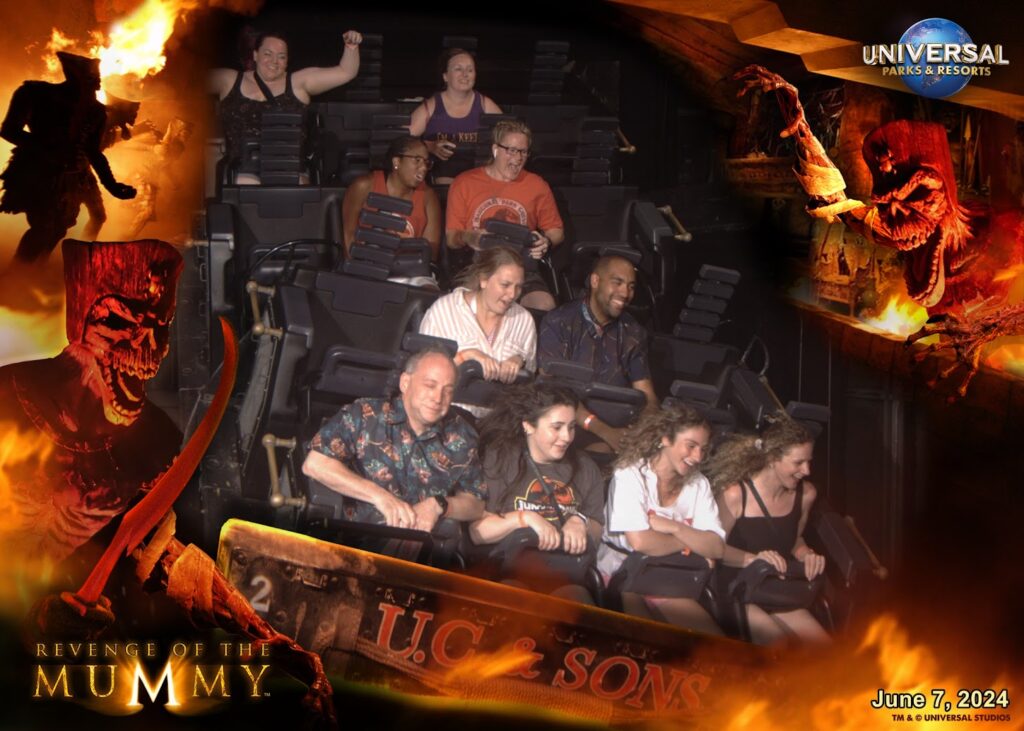
One attraction we make a point to revisit during our classic parks time was Revenge of the Mummy in Universal Studios Florida (it remains one of my middle daughter’s favorites). This coaster opened in 2004 and has been one of my all-time favorites since day one. Every time we’re at Universal, I make sure we ride it again. The special effects, the sudden launches and drops, the ancient tomb atmosphere, it’s a complete sensory experience with just the right amount of cheesiness that doesn’t rely on being brand new to be effective.
The attention to detail in the queue, the seamless integration of coaster mechanics with practical effects, the way the ride builds tension and then pays it off point to all of the new innovations that have been made in the parks. The animatronics still look great. The pacing still feels perfect. Even after countless rides over 20+ years, it hasn’t lost any power.
That’s the mark of a truly great attraction: it works whether you’re experiencing it for the first time or the fiftieth time. Mummy does that. It’s a ride I’ll bring my grandkids to one day, and I’m confident it will thrill them just as much as it thrilled their parents.
(And yes, we got the requisite ride photo mid-scream, which is the only way to properly document an encounter with an ancient curse.)
Universal Resorts vs. Off-Site Hotels: Strategic Lodging
Where you stay shapes your Universal experience just as much as at Disney. Here’s what I’ve learned from multiple stays:
On-Site Universal Hotels: What You’re Actually Getting
Universal offers several tiers of on-site hotels, each with different perks and price points. Understanding these tiers—and what they actually include—is critical to making a smart decision.
Value Resorts (Cabana Bay, Aventura, Dockside Inn): $200–300+ per night. These offer Early Park Admission and complimentary transportation but no Express Pass included.
Premier Resorts (Hard Rock Hotel, Loews Portofino Bay, Loews Royal Pacific): $400–600+ per night. These are the big-ticket properties, and here’s the crucial detail: they include Unlimited Universal Express Pass for Universal Studios Florida and Islands of Adventure, a perk worth $199.99+ per person per day. However, and this is critical, Express Pass does not apply to Epic Universe or Volcano Bay. So if you’re visiting primarily for Epic Universe, the Express Pass inclusion is irrelevant. You’d be paying $400–600+ per night for a perk you can’t use at the new park. This is an important strategic consideration. The Express Pass benefit made sense when Premier hotels were the only luxury options. With Epic Universe now open, staying at a Premier resort for an Epic-focused trip means paying premium prices for a benefit that doesn’t apply to your primary destination.
Epic Universe-Specific Resorts (Universal Helios Grand Hotel): $600–1,000+ per night, often exceeding $700+ per night depending on dates and view tier. This is the newest luxury property built at Epic Universe. Helios Grand offers something entirely different from the classic Premier resorts: a dedicated private entrance directly into Epic Universe. You literally walk out of the hotel lobby into the park. But here’s the trade-off, Helios Grand does not include Unlimited Express Pass for any park. Universal’s explicit strategy with Helios was to prioritize location and direct park access over the Express Pass perk. This is a fundamentally different value proposition. You’re paying for convenience and immersion, not for reduced wait times.
All hotel tiers include Early Park Admission, which gives you up to one hour of early entry into the parks. During opening season of a new park (like our Epic Universe visit), or on peak-season days, Early Entry alone is worth the on-site premium. We walked straight onto Harry Potter and the Battle at the Ministry while standby guests were still gathering at rope drop. That’s a guarantee of experiencing the most popular attraction before waits become insurmountable.
Additionally, hotel guests receive complimentary parking at the parks (though self-parking at the hotel itself costs extra at some properties). You get priority restaurant reservations and access to some resort-exclusive events and merchandise. All on-site hotels offer complimentary transportation throughout the Universal resort.
Off-Site Hotels: Where Value Often Wins
We stayed at Fairfield Inn & Suites for most of our June trip: $472.50 for three nights, or roughly $157 per night for a room sleeping five. Compared to Cabana Bay’s nightly rate, that’s a significant savings. Free breakfast added real value. The only real cost was a few minutes of driving to the parks, which we honestly didn’t mind.
Other nearby hotels worth considering: Marriott properties near Universal (often with better room quality and service than value resorts), Holiday Inn Express, and other established chains. Many are within a 5–10 minute drive of the parks.
The trade-off is straightforward: you lose Early Entry and some convenience, but you gain budget flexibility and often a higher-quality hotel experience.
When On-Site Makes Financial Sense
On-site is worth the premium if: (1) You’re visiting during peak season when Early Entry will save you 2–3 hours of standing in lines on your busiest park days; (2) You plan midday breaks at the resort (families with very young children or heat-sensitive travelers); (3) You want to maximize immersion and staying in the Universal experience; (4) You’re visiting opening season of a new park (Early Entry becomes genuinely critical).
On-site doesn’t make financial sense if: (1) You’re visiting during a slower season when waits are already manageable; (2) You won’t be returning to your hotel midday; (3) You’re comfortable with 5–10 minutes of drive time; (4) Budget is your primary concern; (5) You’re visiting primarily for Epic Universe and considering a Premier resort because the Express Pass benefit doesn’t apply, so you’re overpaying for a irrelevant perk.
Our strategy: Split stay. One night on-site at Cabana Bay for Early Entry on our Epic Universe day, then three nights at Fairfield Inn. Cost for the whole lodging: $732.38 for four nights. If we’d stayed entirely on-site at Cabana Bay, we’d have spent $900–1,200. If we’d chosen a Premier resort (which many families do out of habit), we’d have spent $1,600–2,400 for four nights, and the Express Pass wouldn’t have helped us at Epic Universe. That savings of $868–1,668+ funded our Express Passes and more.
The Helios Question: Is Direct Park Access Worth It?
If budget were unlimited and you were exclusively visiting Epic Universe, Helios Grand would be tempting. Walking directly into the park, having a room overlooking Celestial Park, being able to pop back to your room in five minutes for a break, that’s genuinely valuable. But at $700+ per night with no included Express Pass, you’d be investing $2,800+ for a four-night stay plus $1,400+ for Express Passes for your group. That’s $4,200+ before food, parking at the hotel, or activities. Compare that to our split-stay strategy: $732 for lodging plus $1,400 for Express Passes = $2,132. You’d be paying roughly $2,000 more for the privilege of a shorter walk to the park entrance. For most travelers, that math doesn’t work. Helios Grand is better positioned for guests who are splitting time between Epic and the classic parks, want the hotel itself to be a premium experience (not just a place to sleep), and have budget flexibility.
Of course, it always makes sense to see what Universal is offering for vacation packages to see how the math works out for you.
Express Pass: The Decision-Making Framework
Express Pass is the most expensive and most debated Universal purchasing decision. Getting it right saves hundreds of dollars and eliminates vacation stress.
Understanding What Express Does (and Doesn’t Do)
Express Pass doesn’t guarantee short waits; it guarantees shorter waits than standby. On a busy day, “shorter” might still mean 20–30 minutes instead of 60–90 minutes. On a slower day, Express might mean 5-minute waits instead of 15-minute waits, making the premium less worthwhile.
Express is most valuable on opening days of new attractions or during peak season (summer, Christmas, spring break) when standby waits are genuinely brutal.
Critically, Epic Universe Express Pass is a standalone purchase. It is not included with any Universal hotel, including Premier resorts (Hard Rock, Portofino, Royal Pacific) or the new Helios Grand. If you want Express at Epic Universe, you must buy it separately at $279.99+ per person. This is a recent policy and represents a significant change from how Express worked at the classic parks.
Our June 2025 Express Math
We paid $279.99 per person × 5 people = $1,399.95 for one day of Express at Epic Universe.
Without Express on opening day of Epic Universe, we estimated seeing 4–5 major attractions in a full day. With Express, we experienced approximately 10 major attractions plus several repeat rides. That’s roughly double the ride count.
Was $1,400 worth doubling our attraction count? For us, absolutely. We had one day in the park. Every minute counted. The alternative, standing in 60+ minute standby lines, would have meant seeing half the park, leaving frustrated.
For a multi-day trip during a slower season? We probably would have skipped Express and relied on strategic timing (arriving early, visiting attractions at off-peak hours, staying late into the evening).
When to Skip Express
On quieter days (January through early March, September, early November), standby waits at classic attractions are often 15–30 minutes. Express isn’t necessary. Use those days to explore, take photos, enjoy meals without rushing, revisit favorites. You’ll spend less and enjoy the parks differently, less like a race, and more like an experience.
During multi-day visits, skip Express on your slowest park days and buy it only for your peak-season or opening-attraction days. Mix your approach based on expected crowds, not out of habit.
Practical Takeaways for Your Universal Trip
If you’re planning a Universal vacation, whether to Epic Universe or to revisit the classics, here’s what our June 2025 trip taught me:
Plan your on-site stay strategically. If you need Early Entry, book just one or two nights on-site at a value resort (Cabana Bay offers the best bang for buck), then move to an off-site hotel to save $100–150+ per night. Early Entry on your highest-value day is worth far more than staying on-site for your entire trip. Avoid staying multiple nights at a Premier resort if you’re primarily visiting Epic Universe. The included Express Pass won’t apply there, making you overpay for an irrelevant perk.
Time your Express Pass purchase with crowd expectations. Request the crowd calendar from Universal’s website or check independent sources like TouringPlans. If your dates are red/orange (busy), Express is worth serious consideration. If your dates are yellow/green (slower), you might skip it entirely and use early arrival and late evenings instead. Remember that Epic Universe Express Pass is a standalone purchase not included with any hotel.
Understand what hotel Express Pass actually covers. If you’re considering a Premier resort (Hard Rock, Portofino, Royal Pacific) for the included Express Pass, verify that you’re planning to spend significant time at Universal Studios Florida and Islands of Adventure. The included Express Pass doesn’t apply to Epic Universe or Volcano Bay. If Epic Universe is your primary destination, the Express Pass benefit is moot.
Use Early Entry ruthlessly. If you’re staying on-site, wake up early and hit the biggest headliners during Early Entry, before the general public arrives. One hour of Early Entry can knock out 2–3 major attractions, a genuine competitive advantage.
Plan around your group’s tolerance. Not everyone loves waiting in lines. Not everyone loves walking 750 acres. Not everyone wants to ride the same thing twice. Build flexibility into your day so that people can branch off, rest, or repeat favorites without making others miserable. Our group split up occasionally to let some rest while others kept exploring.
Revisit the classics. If you’re going to Epic Universe, don’t skip the original parks. Revenge of the Mummy, the Hogwarts Express, Islands of Adventure, are still phenomenal, and they give you perspective on how far theme park technology has come. Plus, some attractions are genuinely better the second or third time through, when you’re not rushing.
Give yourself time to just exist in a land. The best moments at Universal aren’t always the big attractions. They’re the moments when you’re walking through a themed area, noticing the details, taking photos, and just savoring the immersion. Budget time for that. We could have ridden more attractions, but the memories we got from simply existing in each world are what matter.
Bring motion sickness relief if you’re prone to it. Some Universal attractions, particularly the motion-simulator rides, can trigger nausea for sensitive guests. We’ve had family members need a break after Fast & Furious or Kong Skull Island, and worse on at least one of the Harry Potter rides. Dramamine or ginger-based remedies help. Don’t push through if motion is an issue; it ruins the day and the next several hours.
Plan your dining in advance during peak season. Universal’s restaurants get absolutely slammed during opening summer. Make mobile or advance dining reservations for sit-down meals, especially at CityWalk spots like Toothsome. Walk-up spots are available, but waits can be 30+ minutes during peak times.
Hydration and sunscreen are non-negotiable. Epic Universe’s layout is sprawling and often exposed. The central hub has shade, but many areas don’t. We applied sunscreen twice during our day and still ended up with mild sun exposure. Bring a refillable water bottle (they allow empty bottles into the park). The hydration break often felt like the best part of our day.
Final Thoughts
Universal Orlando has been a constant in my family’s travel life for 25 years. We’ve watched it grow from Jaws and Twister to Harry Potter and now to Epic Universe, with its Nintendo Worlds and AR goggles and trackless dark rides. The park has reinvented itself multiple times while still feeling like itself. We made a point of being there for Velocicoaster’s opening summer, and we were there for Epic Universe’s debut. And we’ll keep coming back, because that’s what Universal does, it gives you a reason to return.
If you’re thinking about a Universal vacation, especially if you want to experience Epic Universe in its inaugural year, I’d love to help you plan it. As a travel advisor at Mouse One Travel, I book these trips regularly and visit the parks multiple times a year to stay current on operations, wait times, and the little changes that can make or break a vacation. The planning matters. The strategy matters. The small decisions, like staying one night on-site, can save you thousands of dollars and hundreds of hours of stress.
Whether you’re a longtime Universal fan like me or a first-timer curious about what all the fuss is about, reach out. Let’s build you an Epic adventure together.
Frequently Asked Questions
These FAQs are based on our own Universal Studios experiences.
Should I stay at a Premier hotel (Hard Rock, Portofino, Royal Pacific) if I’m visiting Epic Universe?
While personal preferences always factor into these decisions, I would say not unless you’re planning to spend significant time at Universal Studios Florida and Islands of Adventure. The included Unlimited Express Pass doesn’t apply to Epic Universe. If Epic is your primary destination, you’d be overpaying for a perk you can’t use. Consider a value resort with one-night Early Entry instead or book an off-site hotel and buy Express Pass separately for Epic Universe if needed.
Does the free Express Pass at Premier hotels include Epic Universe?
No. The Unlimited Express Pass included with Hard Rock Hotel, Loews Portofino Bay, and Loews Royal Pacific applies only to Universal Studios Florida and Islands of Adventure. It does not apply to Epic Universe or Volcano Bay. If you’re staying at a Premier resort specifically for the Express Pass benefit, verify that you’ll be spending sufficient time at the classic parks to make the premium room rate worthwhile.
What’s the difference between staying at Helios Grand Hotel vs. a Premier resort for Epic Universe?
Helios Grand ($600–1,000+/night) offers a dedicated private entrance into Epic Universe and hotels rooms overlooking Celestial Park, but no included Express Pass. Premier hotels ($400–600+/night) include Unlimited Express Pass for the classic parks (not Epic). If you’re exclusively visiting Epic Universe, Helios offers proximity and immersion but at a higher price with no Express benefit. For most travelers, a value resort with one-night Early Entry plus off-site lodging is a better financial strategy.
Should I stay at Cabana Bay for Early Entry if I’m only visiting for one day?
It depends on your priorities. One night at Cabana Bay ($260) plus Early Entry access might save you 2–3 hours of waiting in lines. If Express Pass is off the table for your budget, Early Entry alone can be the difference between seeing most of the park and seeing half of it. We thought it was worth the cost, especially combined with Express Pass to maximize our single-day experience.
How much does Express Pass actually save in time?
On opening day of Epic Universe, Express dropped waits from 60–90 minutes down to 10–20 minutes consistently. That’s 40–70 minutes saved per attraction. Across 10 attractions, that’s 400–700 minutes (roughly 7–12 hours) saved. Express paid for itself multiple times over in time savings alone.
Is Epic Universe worth a dedicated trip, or should I combine it with the classic parks?
It’s worth combining. Epic Universe is massive, but one full day (with Early Entry and Express) let us see most of it. Adding a second day at the classic parks gave us a richer experience and let us revisit favorites. If you can only do one park, make it Epic and plan for a long, exhausting day.
Which hotels offer the best value near Universal?
Cabana Bay is often the most affordable Universal resort and includes the same Early Entry perk as the premium properties. For off-site, Fairfield Inn is reliable and well-located. We saved about $150–200 per night by staying there versus staying on-site for all three nights.
What’s the best time of day to visit Epic Universe if I can’t do Early Entry?
The park is calmest in the first 30 minutes after opening (if you can arrive that early) and after 8:00 PM when day guests start leaving. Midday (11:00 AM–6:00 PM) is peak chaos. Early evening (6:00 PM–close) is a sweet spot if you’re willing to stay late.
Do I need to pay for parking at Universal hotels?
Yes, self-parking is $26 per night at Cabana Bay (subject to change). Premier hotels and newer resorts may have different parking policies. Check your resort confirmation. Off-site hotels may or may not include parking. Helios Grand guests typically don’t pay for self-parking at the hotel due to the property’s premium positioning.
When should I start planning a Universal vacation?
Begin planning 4–6 months before your trip so you can choose ideal dates, compare hotels, watch for ticket discounts, and decide on Express Pass strategy. For opening-season trips like ours, booking earlier (6–9 months) helps secure on-site hotel availability.
What is the first step in planning a Universal vacation?
The first step is deciding your travel dates and length of stay, then setting a realistic total budget for resort, park tickets, dining, and entertainment. Determine whether you want to handle planning yourself or work with a travel advisor who can help optimize your resort choice, ticket strategy, and Express Pass decision.
How do I choose the best Universal resort for my family?
Focus on your family’s travel style: on-site Universal resorts offer Early Entry and immersion but cost more; off-site hotels offer better value and often higher room quality; vacation rentals work well for large or extended-stay groups. Match the resort tier to your priorities and budget. If visiting Epic Universe primarily, skip Premium hotels unless you’re combining with the classic parks.
Is it better to stay on-property or off-property at Universal?
On-property works best if you plan midday breaks, need Early Entry for a peak-season day, or want to stay immersed in the Universal experience. Off-property often wins on value, room quality, and budget flexibility, making it ideal if you’re park-hopping all day and won’t return to your room midday. For Epic Universe specifically, a one-night on-site stay for Early Entry plus off-site lodging is often the sweet spot financially.
How many park days do I need for a Universal vacation?
Epic Universe alone needs at least one full day to experience most attractions (more if you skip Express Pass). Add 1–2 days for the classic parks (Universal Studios Florida and Islands of Adventure). Most families find 3–4 park days ideal for a well-rounded Universal experience, though 2 park days is workable with strategic planning, but you will be tired. I recommend a 4-park day plan in order to allow time for immersion in the worlds and a more relaxed pace.
Should I buy Express Pass for every day of my trip?
No. Buy Express Pass only for your peak-season or opening-attraction days when standby waits exceed 45–60 minutes. On slower days, skip it and use early arrival, late evenings, and strategic timing instead. We bought Express only for our opening-day Epic Universe visit and skipped it on other park days. Remember that Epic Universe Express Pass is a separate purchase from classic park Express Pass.
What is the best time of year to visit Universal?
Crowds are lowest in January (after New Year’s), early March (before spring break), early September, and early November. These shoulder-season windows offer shorter waits without the summer heat and peak pricing. Visit during opening season of a new attraction (like our Epic Universe trip) if you want the excitement of seeing something brand new.
How much does a typical Universal vacation cost?
A realistic budget for a family of four includes: $150–200 per night for off-site hotel (2–3 nights = $300–600), $100–150 per person per day for park tickets (4 days = $1,600–2,400), $50–100 per person daily for dining ($800–1,600), Express Pass ($100–300 per person if purchased), and parking/transportation ($50–100). Total: $3,000–6,000+ depending on length, season, and Express Pass usage.
What is your ticket strategy for Universal when visiting multiple parks?
For multi-park visits, multi-day base tickets offer better per-day value than single-day tickets. Evaluate whether you need Park-to-Park admission (allows travel between parks via Hogwarts Express and Skyliner) based on your itinerary. For our June trip, we purchased individual 1-day tickets to Epic Universe plus separate tickets to the classic parks, which worked with our split-park itinerary.
Are there special options for military families at Universal?
Universal offers military discounts on tickets (available through MWR facilities, military-affiliated websites, or at the gate) and discounted rates at some resorts. Compare military-discounted tickets against civilian ticket prices and watch for promotional offers. Base your decision on total vacation cost, not just ticket price.
How can I plan a Universal trip for both kids and adults to enjoy?
Balance your Universal planning by mixing thrill rides (Velocicoaster, Mummy) with family-friendly attractions (Yoshi’s Adventure, ET Adventure), character experiences, shopping, quality dining, and immersive land exploration. Let adults experience some attractions without children if your group allows it, and let kids enjoy their priority attractions without rushing.
What should I know about motion-sickness triggers at Universal?
Motion-simulator attractions (Fast & Furious, Kong Skull Island, Harry Potter and the Forbidden Journey) can trigger nausea in sensitive guests. Bring Dramamine or ginger-based remedies. Skip these if motion is a known issue. The good news: many Universal attractions aren’t motion-simulators, so you have plenty of alternatives.
Why should I use a travel advisor for Universal planning?
A travel advisor who visits Universal regularly (like at Mouse One Travel) can help you match your resort choice to your budget, optimize your Express Pass strategy, navigate the complex ticket options, and design a realistic daily plan that balances crowds, attractions, and rest. For first-timers or families planning opening-season trips, advisor guidance saves time, money, and vacation stress.
How do I prepare for visiting Epic Universe in peak season?
Book on-site hotel accommodations 6–9 months in advance for Early Entry access. Purchase Express Pass once crowd forecasts solidify (typically 2–3 months before). Make dining reservations early using the Universal mobile app. Wear comfortable shoes, bring sunscreen and a refillable water bottle, download the Universal app for real-time wait times, and plan your must-do attractions to prioritize during Early Entry.
What’s the best strategy for visiting with younger children at Universal?
Universal has height requirements on many attractions, limiting options for very young children. Plan kid-friendly attractions like Seuss Landing, Dreamworks Land, Skull Island, and Yoshi’s Adventure. Use the Rider Switch program (ask a team member) to let one adult wait with sleeping children while another rides without losing their spot. Consider shorter park days (10:00 AM–4:00 PM) to align with nap schedules.
Is Helios Grand Hotel worth the premium price?
Helios Grand is best positioned for guests who value hotel experience itself (not just lodging), want the prestige and views of being on-property in a brand-new luxury resort, are willing to pay for convenience (direct park entrance), and have budget flexibility. For budget-conscious families or those focused purely on park efficiency, the value prop is weaker. The direct park access is genuinely valuable, but at $700+/night plus separate Express Pass purchase, costs add up quickly.